
 @endphp
A Shared Approach to Change
The University of Wisconsin–Madison is a large, complex organization that is continuously evolving. New processes, policies, and priorities affect campus life every day. How we navigate those changes matters.
Successful change takes more than a good plan. It requires attention to how people experience and respond to change. Supporting and strengthening our foundation, including our people, culture, and operations, is essential to delivering on our mission for generations to come. To support that work, campus leadership partnered with change practitioners from across campus to develop S.E.A.T., a change management framework for the university community.
S.E.A.T. stands for Stage, Engage, Act, and Thrive. It’s a practical, people-centered approach to leading change at UW–Madison. It helps you define what is changing, engage those affected, support adoption, and sustain change over time. It also reflects UW–Madison’s commitment to fostering a workplace where excellence and employee well-being go hand in hand, recognizing that successful change depends on people having the support they need to succeed.
Whether you’re responding to new research requirements or supporting one of UW–Madison’s strategic priorities, S.E.A.T. can help you navigate change while keeping people at the center of the process.

Turning to an Icon for Inspiration
The change practitioners who collaborated on the framework wanted to create an acronym and accompanying visual that felt both specific to the university and universally known by its community.
Inspired by the university’s Sunburst Terrace chairs, this home-grown approach embodies the cyclical nature of change, the forward-thinking ethos of our community, and the act of coming together to support an initiative.
Developed for UW–Madison, by UW–Madison
This home-grown approach helps ensure that Badgers have an actual and metaphorical seat at the table.
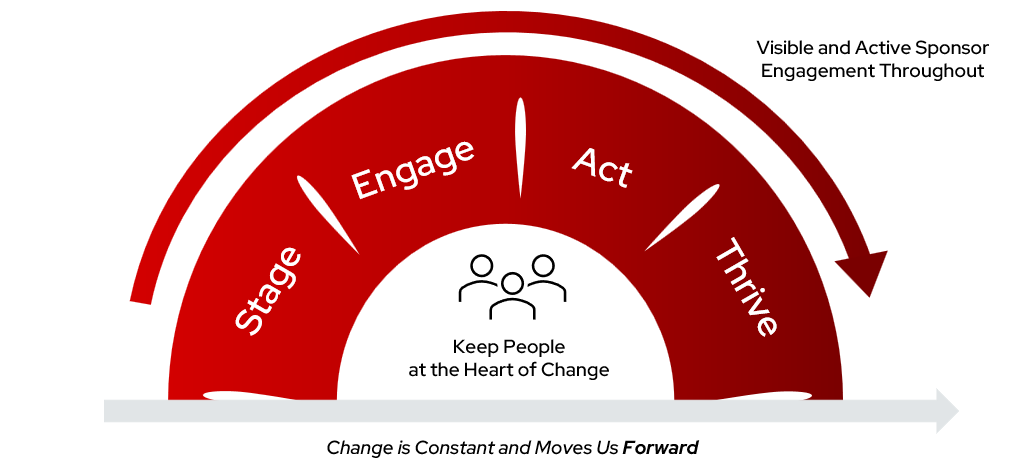
Discover the Framework

Framework Visual & Checklist
The framework visual, paired with a high-level checklist to help you—and your team—stay on track.

Toolkit
Reflective worksheets to guide conversations at every phase of the change process.

Presentation Slides
Branded graphics and language to help you share S.E.A.T. at your next meeting.

Stage
Determine Your Purpose
- Align with institutional priorities.
- Clarify what is changing and why it matters.
Chart Your Path
- Assess readiness, capacity, and risks.
- Define success and desired outcomes.
- Establish clear goals and measures.
Engage
Create Trust
- Identify and prioritize key stakeholders.
- Align leadership, governance, and decision makers.
- Build shared understanding and awareness of the change and its impact.
- Listen to understand needs and concerns.


Act
Develop the Roadmap
- Define scope, roles, and key milestones.
- Build integrated plans (e.g., communications, training, support, and risk mitigation).
Implement the Change
- Implement training, communications, and support.
- Monitor adoption, utilization, and performance.
- Incorporate feedback and continuously improve.
Thrive
Make it Stick
- Embed the change into roles, processes, and systems.
- Reinforce new behaviors and expectations.
- Establish ongoing ownership and accountability.
Evaluate Your Success
- Monitor adoption and address setbacks.
- Recognize and celebrate progress.

Share Your Change Story
If you’ve used the framework, we’d like to hear about it. Please let us know what’s working, where there’s room for continuous improvement, and what’s worth sharing. Contact Jen Erickson at jennifer.erickson@wisc.edu.